 Our Offices: London | Manchester | Open 7 Days



Indefinite Leave to Remain – ILR Application Guide for 2026
If you’re living in the UK on a visa and dreaming of permanent settlement, Indefinite Leave to Remain (ILR) is likely the next crucial step in your immigration journey. It’s the status that gives you genuine freedom no visa renewals, no restrictions on work, and the pathway to British citizenship.
But let’s be honest: getting ILR isn’t straightforward. The application process is demanding, the eligibility criteria are strict, and one wrong move can cost you your application fee and years of planning. That’s why understanding exactly what ILR is, how to qualify, and what pitfalls to avoid is so important.
This guide walks you through everything you need to know about Indefinite Leave to Remain in 2026 from eligibility requirements to the step by step application process, plus what changes might be coming your way.
What is Indefinite Leave to Remain?
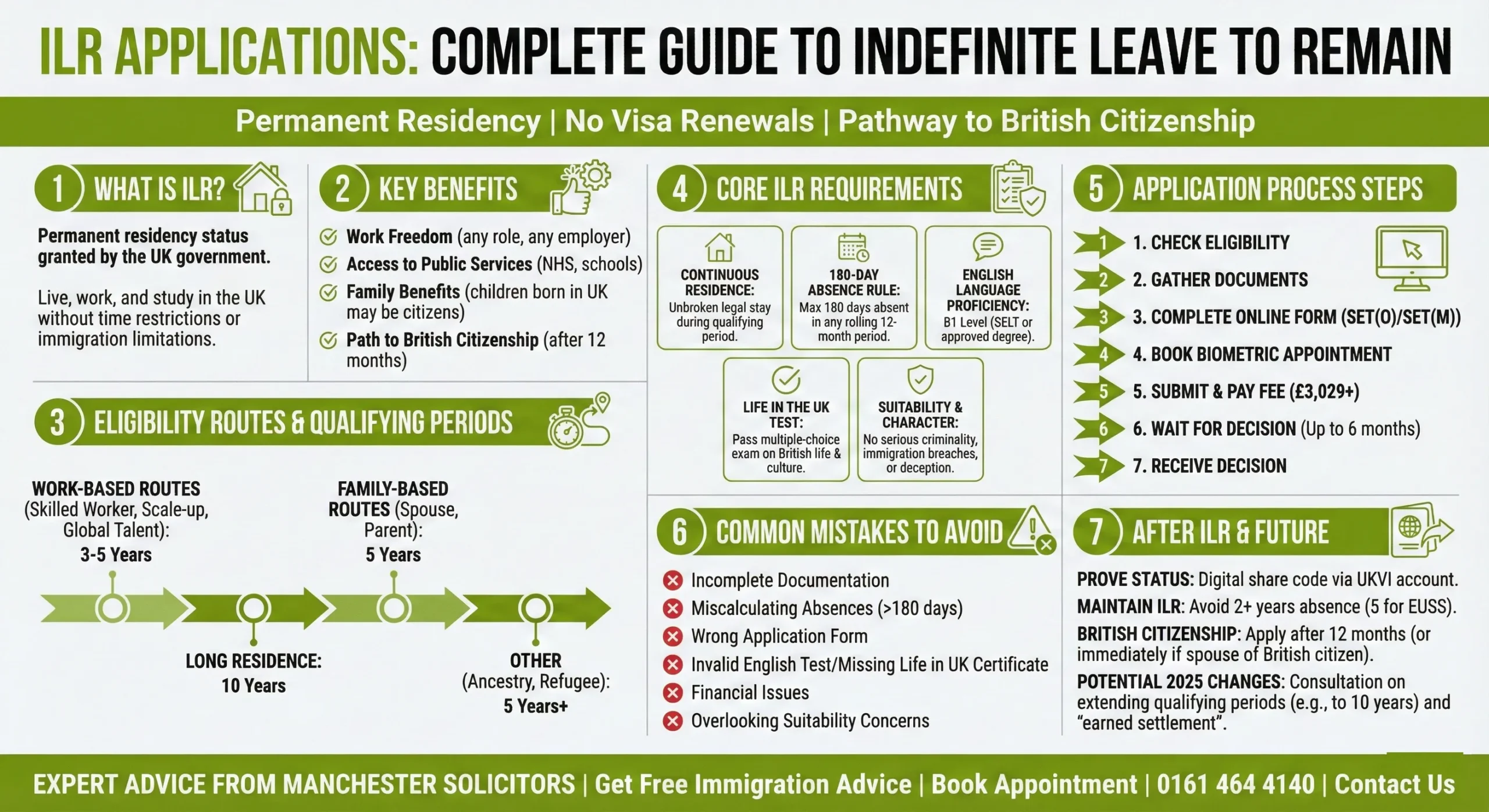
Indefinite Leave to Remain (ILR) is permanent residency status granted by the UK government. Once you have ILR, you can live, work, and study in the UK without any time limit or immigration restrictions. It’s the status that sits between your current visa and British citizenship and for many people, it’s the moment they finally feel settled.
Unlike temporary visas that expire after a set period, ILR doesn’t come with an expiry date. You don’t need to renew it, justify your presence each year, or worry about losing your right to work. It’s genuinely indefinite which is where it gets its name.
The Real Benefits of Indefinite Leave to Remain
Getting ILR means several things change for the better:
You can work anywhere, in any role, without restrictions. With ILR, employment authorisation is built in. You’re no longer tied to a specific employer (as you would be on a Skilled Worker visa), restricted to certain professions, or bound by salary thresholds. You can change jobs freely, become self-employed, start a business, or move into new industries. There are no working hour limitations, no requirements to have a sponsored role, and no sponsorship certificate to worry about.
Access to public services becomes the same as for British citizens. ILR holders can use the National Health Service (NHS) without the restrictions that apply to temporary visa holders. You can access social support, local authority services, and benefits if you’re eligible. Your children can attend state schools and universities on the same terms as UK citizens, with access to student loans and grants.
Family benefits and dependants change in your favour. Any child born to you in the UK while you hold ILR status automatically becomes a British citizen. You can bring eligible family members to the UK to join you—spouses, partners, children, and in some cases, dependent relatives. This stability often matters enormously to families who’ve been separated by immigration rules.
You’re one step away from British citizenship. ILR is the essential prerequisite for applying to become a British citizen through naturalisation. While ILR gives you permanent residency, British citizenship gives you a passport, voting rights, and complete equality with those born in the UK.
How ILR Differs from Other UK Immigration Statuses
It’s worth understanding how ILR sits alongside other immigration categories, because the differences matter.
ILR vs. Temporary Visas (Skilled Worker, Student, Family): Temporary visas come with an expiry date. Whether you’re on a Skilled Worker visa, Student visa, or Family visa, your permission to remain lasts for a set period—typically 2 to 5 years. When your visa expires, you either have to leave the UK, apply to extend that visa, or apply for a different status. You’re also subject to specific conditions if you’re on a Skilled Worker visa, you must work for your sponsor; if you’re on a Student visa, you must be studying. ILR removes all of that. No expiry date. No sponsor dependency. No activity restrictions.
ILR vs. Limited Leave to Remain: Limited leave is the official term for any temporary visa. You have permission to remain, but only until a certain date. You can’t access most welfare benefits, you might have restrictions on work or study, and your time is measured in months and years, not indefinitely. ILR flips this entirely the leave is unlimited, benefits access is broader, and you have complete freedom to work in any capacity.
ILR vs. British Citizenship: This is a question we hear often. ILR sounds like citizenship, but it’s not quite the same. ILR holders can live and work in the UK on a permanent basis, access public services, and bring family members to join them. What ILR doesn’t give you is a British passport, voting rights in general elections, or the full legal protection of citizenship (though ILR holders have substantial rights). To get those things, you need to apply for naturalisation as a British citizen. The good news is that ILR is the essential stepping stone to citizenship you generally need to hold ILR for at least 12 months before applying.
ILR vs. EU Settlement Scheme (EUSS) Settled Status: If you’re a European, EEA, or Swiss citizen who was in the UK before 31 December 2020, you may have applied for EUSS settled status as part of the Brexit settlement scheme. That status is equivalent to ILR it gives you permanent residency rights. However, the rules are slightly different. EUSS applications are now closed to most new applicants, and EU citizens who arrived after 1 January 2021 cannot use that route. If you’re an EU citizen who arrived after the deadline, you’d apply for ILR in the same way as any other applicant. One important difference: EUSS settled status generally lapses after five years of absence from the UK (or four years for Swiss citizens), whereas standard ILR lapses after two years of absence.
ILR vs. Long Residence Settlement: Long residence is actually a route to ILR, not a status in itself. If you’ve lived in the UK lawfully for at least 10 consecutive years, you may be eligible to settle directly to ILR, regardless of your visa route. This is useful if you’ve been in the UK a long time but on routes that don’t normally lead to settlement.
Who Can Apply for Indefinite Leave to Remain?
Not every visa route leads to ILR. The UK has specific pathways to settlement, and you need to be on one of them (or meet special circumstances) to be eligible.
The Main Routes to Indefinite Leave to Remain
Work based routes: These make up a significant proportion of ILR applications. If you’re on a Skilled Worker visa, you can apply for ILR after 5 years of continuous residence. The same applies to other work visas like the Scale-up Worker visa, Global Talent visa, International Sportsperson visa, or Innovator Founder visa. Some routes offer faster settlement for example, Global Talent visa holders with recognised endorsements can sometimes settle in just 3 years. Tier 1 legacy routes (Investor, Entrepreneur) may have different timelines, typically 2 – 5 years depending on the category.
Family based routes: You can settle based on family relationships. A Spouse visa typically requires 5 years of continuous residence before you can apply for ILR. Parent visas also lead to settlement after 5 years. Adult dependent relative visas, child dependent visas, and private life routes can all potentially lead to ILR, though timelines vary. If your partner has died or your relationship has ended due to domestic violence, special provisions may apply.
Ancestry visas: If you have British ancestry and hold an Ancestry visa, you can settle after 5 years of continuous residence.
Long residence route: If you’ve lived in the UK lawfully for at least 10 years, you may be eligible for ILR regardless of your visa route. This is a safety net for people who’ve been in the UK a long time.
Refugee and humanitarian routes: People who’ve been granted refugee status or humanitarian protection can access settlement routes. The timelines vary, but refugees typically have a faster route to permanent residency than other migrants.
Other special routes: Armed forces personnel, returning residents (people whose previous ILR has lapsed), and certain legacy cohorts may have access to settlement.
Understanding Qualifying Periods
Most people applying for ILR need to have been in the UK for a certain length of time continuously. Here’s the quick breakdown:
- 5 years: The most common requirement. Skilled Worker, Spouse, Parent, Ancestry, and many other routes require 5 years.
- 3 years: Some routes like Global Talent (with endorsement) or Innovator Founder offer settlement after 3 years.
- 2 years: Tier 1 Investor legacy routes (for existing holders).
- 10 years: The long residence route, available to anyone who’s been here lawfully for a decade.
The key word here is “continuous.” Your residency needs to be unbroken. But what does that actually mean? We’ll get into the detail in a moment.
Core ILR Requirements You Must Meet
Qualifying for ILR isn’t just about checking off the years. The Home Office has strict eligibility criteria, and you need to evidence every single one. Miss something, and your application could be refused—and you’ll lose your application fee with it.
The 5-Year Continuous Residence Requirement
Let’s start with the most fundamental requirement: living in the UK continuously for the qualifying period (usually 5 years).
“Continuous” sounds simple, but in immigration law, it has a very specific meaning. It means you’ve been physically present in the UK for the entire qualifying period, on valid leave. You haven’t broken your residency by being out of the country for too long, and you’ve maintained a right to be here throughout.
The clock starts when your visa is first granted (not when you enter the UK, though there’s a nuance here we’ll explain). It runs forward for your qualifying period typically 5 years. On the date your qualifying period is complete, you become eligible to apply for ILR.
Here’s something helpful: you don’t have to wait until that exact date. You can apply up to 28 days before you reach your qualifying period. This is useful if you’re planning ahead and want to get your application in the queue.
Calculating your start date: The start date is usually the date your visa is granted. However, if you were issued entry clearance and entered the UK within 180 days of that grant date, the start date can be counted from the grant date even though you weren’t yet in the country. For example, if your entry clearance was granted on 1 November 2024 and you entered on 15 December 2024, your qualifying period starts on 1 November 2024 (the grant date), not 15 December. This is actually helpful because it gets you to your ILR date sooner.
Unsure about your qualifying date? Try our free ILR calculator to determine your earliest application window.
But here’s the critical bit: if you were issued entry clearance and didn’t enter the UK within 180 days, then the period between grant and entry counts as absence. That absence uses up your allowance.
Combining time on different visas: In some cases, time spent on different visa routes can count toward your qualifying period. This is most common with work visas. If you moved from one work visa to another (say, from Student to Skilled Worker), you may be able to combine your time. However, this depends on the specific routes and whether they’re compatible. If you’ve moved between completely different visa categories (e.g., Family to Work), the rules are stricter. Always check before assuming your previous time counts or take advice to be certain.
Time that doesn’t count: If you’ve been on routes that don’t lead to settlement (like a Visitor visa, Standard Visitor route), that time doesn’t count at all toward your ILR qualifying period. You’d need to be on a visa route that leads to settlement.
Understanding the 180-Day Absence Rule
This is where things get tricky for many applicants. The 180 day rule is one of the most common reasons for ILR refusals, and it’s easy to get wrong if you’re not careful.
Here’s the rule: during your qualifying period, you can’t spend more than 180 days outside the UK in any rolling 12-month period. That’s about 6 months in every calendar year but it’s a rolling rule, not a calendar-year rule, which makes a difference.
What counts as an absence: Every full day outside the UK counts. Annual leave, business trips, holidays, compassionate travel, working offshore it all counts. Only part-days don’t count. If you leave on Monday and return on Friday, that’s 4 days absent (Tuesday, Wednesday, Thursday, Friday), not 5. But if you leave on a Monday morning and return on a Friday afternoon, it’s still just 4 full days.
What doesn’t count as absence: There are limited exceptions, but they do exist. If you can demonstrate “serious or compelling reasons” for absences, those may be disregarded. The Home Office guidance suggests this applies to situations beyond your control for example, medical emergencies, hospitalisation, or family crises. COVID-related travel disruptions have been accepted in some cases, provided you can evidence that the absence was genuinely beyond your control. However, these exceptions are the rule rather than the exception, and the bar is high.
How the rolling 12-month period works: This is crucial. It’s not a calendar year. It’s every rolling 12 months. So if you have 150 days of absence between January 2024 and December 2024, you might think you’re fine. But if you then have 40 days of absence between January 2025 and June 2025, you need to check the rolling 12-month period from July 2024 to June 2025. That’s 150 + 40 = 190 days in a rolling 12-month period, which exceeds the 180-day limit. Your residency is broken.
This is why meticulous record-keeping matters so much. You need to track your absences accurately from day one.
Planning around business travel: If your work involves regular travel abroad, this is worth thinking about carefully. A manager who travels every month might rack up absences quickly. An offshore worker (oil rig, for example) is treated as absent for every day outside UK territorial waters. A consultant with frequent client visits abroad needs to count each one. The solution is to plan your travel pattern and keep clear records. Work with your employer to document the reasons for your absences a letter from your employer confirming dates and business purposes is helpful evidence.
Absence exceptions that might apply:
- Serious or compelling family circumstances: A relative’s death, a medical emergency requiring treatment abroad.
- Institutional care: Hospitalisation abroad, though this is rare.
- Forces exemptions: If you’re a spouse or partner of someone serving in the armed forces abroad, different rules apply. You can stay abroad without breaking your residence if your partner is posted overseas.
- Government employees: If you’re posted abroad as part of UK government work, you may have exemptions.
English Language Proficiency: Meeting the Requirement
The UK requires ILR applicants to prove sufficient English language ability. This isn’t just bureaucratic red tape it reflects the principle that people settling permanently should be able to communicate effectively in the country they’re choosing to make their home.
The required standard: You need to prove English language proficiency at B1 level (roughly intermediate level). You can understand the main points of clear standard input on familiar matters, produce simple text on topics that are familiar, and engage in straightforward conversation.
How to prove it: There are several recognised ways:
Pass a Secure English Language Test (SELT): This is the most common route. You take an approved test at an accredited test centre. It covers speaking and listening at B1 level. Tests cost around £150 – 250 and can be booked online. You’ll sit the test, and if you pass, you get a certificate that’s valid for life (or at least, for your ILR application). The test isn’t difficult if English is your working language, but if you’re nervous, you can take it multiple times.
Use a degree taught in English: If you already have a degree from a recognised university and it was taught in English, you may be able to use that as evidence. The degree needs to be from a recognised institution in a majority English-speaking country, or from a UK institution. You’ll need an Academic Qualification Level Statement from Ecctis (formerly UK NARIC) to confirm the level and language of instruction.
Nationality exemption: If you’re a national of a country listed as a majority English-speaking country (the US, Australia, Canada, New Zealand, Ireland, etc.), you’re exempt from the English language requirement entirely. You don’t need to take a test or provide a degree.
The Knowledge of Language and Life (KoLL) condition: English language proficiency is actually part of a broader requirement called KoLL– Knowledge of Language and Life. The other part is knowledge of life in the UK, which we’ll cover next. Some categories of applicant are exempt from KoLL, including victims of domestic violence, bereaved partners, certain armed forces personnel, and adult dependent relatives. If you fall into an exempt category, you won’t need to prove English or pass the Life in the UK test.
Passing the Life in the UK Test
The Life in the UK test is a multiple-choice exam that assesses your knowledge of British history, culture, government, and values. It costs £50 per attempt, is taken on a computer at an authorised test centre, and you need to score at least 75% to pass.
What’s on the test: You’ll be asked 24 questions about UK life. Topics include British history (from Roman times through to modern day), the British government and political system, law and justice, rights and responsibilities, culture, leisure, and language. The test is designed to ensure that people settling permanently in the UK have a genuine understanding of the country.
Getting ready: The Home Office provides official study materials online. You can access practice tests, revision guides, and detailed information about all the topics that might come up. Most people who study the material find the test straightforward. It’s not trying to catch you out; it’s genuinely testing whether you have basic knowledge of UK life.
When you’re exempt: If you’re over 65 or under 18, you’re exempt from taking the test. Some categories of applicant are also exempt under the KoLL exemptions we mentioned earlier. But most working-age adults applying for ILR will need to take and pass the test.
Retaking the test: If you don’t pass the first time, you can retake it as many times as you need. There’s no limit on attempts, but you’ll pay £50 for each attempt. Most people pass within one or two attempts after studying the materials.
Suitability and Character Requirements
This is an area where the Home Office applies strict assessment. You need to be suitable for settlement, which means your conduct, immigration compliance, and honesty need to meet the required standard.
The concept of “good character,” which used to apply to ILR, has been replaced (as of November 2025) with “suitability.” Suitability is assessed under the Immigration Rules, and it covers several areas:
Criminality: The Home Office will consider any criminal convictions, whether in the UK or abroad. They’ll look at the nature of the offence, when it happened, and what it suggests about your character. This doesn’t necessarily mean a conviction rules you out, but serious or recent offences, particularly those involving violence, dishonesty, or harm to others, will likely lead to refusal. Minor offences from many years ago may not be an issue. The assessment is case-by-case.
Immigration compliance: Have you complied with UK immigration rules? Have you overstayed any visa, worked without permission, breached visa conditions, or provided false information? Breaches of immigration law are taken seriously and can lead to refusal.
Deception: If you’ve ever provided false information, false documents, or been dishonest in any immigration application, that will be assessed. Deception is a serious issue in immigration law. If the Home Office finds you obtained leave by deception, your ILR can be refused or revoked, and you could face criminal prosecution.
Related conduct: The Home Office also looks at related conduct patterns of behaviour that suggest unsuitability, even if they don’t fit neatly into the categories above.
What you should do: Be honest about your past. If you have any criminal convictions, immigration breaches, or concerns about your suitability, take advice before applying. An immigration specialist can assess whether there are issues that might cause problems and help you decide whether to apply now or wait, or what additional information you should provide.
Visa Specific Requirements and Settlement Salary Thresholds
Different visa routes have different additional criteria at settlement stage. The most common is the salary threshold that applies to Skilled Worker visa holders.
Skilled Worker settlement salary: When you apply for ILR on a Skilled Worker visa, your salary needs to meet the live settlement thresholds at the time of application. These thresholds are set by the Home Office and updated regularly. As of 2025, you need to earn at least £38,860 per year (or meet a going-rate threshold for your occupation). This is checked at the time of your ILR application, not just at the time your visa was granted.
Scale-up Worker earnings: Scale-up visa holders need to evidence earnings as required for settlement on that route.
Other route-specific criteria: Some other routes have specific requirements—for example, certain business routes require evidence that your business is still active and meeting specified criteria.
How to Apply for Indefinite Leave to Remain (Step-by-Step)
To apply for ILR, you must confirm your eligibility based on your visa route, pass the Life in the UK Test, and submit an online application with the correct fee £3,029, (increasing to £3,226 effective 8 April 2026). The process typically follows these six steps:
- Check Eligibility & Absences Verify you have completed the qualifying period (usually 5 years) and have not spent more than 180 days outside the UK in any 12-month period.
- Pass Mandatory Tests Unless exempt, you must pass the Life in the UK Test (£50) and prove B1 level English proficiency (SELT) before applying.
- Complete the Correct Form Submit your application online using Form SET(O) for work-related visas or Form SET(M) for partners/spouses. You can apply up to 28 days before your qualifying period ends.
- Pay the Application Fee As of April 2025, the standard fee is £3,029 per applicant (increasing to £3,226 effective 8 April 2026). You may also choose Priority Service (5 days) for an extra £500 or Super Priority (next working day) for £1,000.
- Attend UKVCAS Appointment After paying, book an appointment at a UK Visa and Citizenship Application Services (UKVCAS) point to provide your biometrics (fingerprints and photo) and scan your supporting documents.
- Wait for Decision Standard applications are processed within 6 months. If successful, you will receive your decision via email and your new BRP (or digital status) shortly after.
Common ILR Application Mistakes to Avoid
We’ve seen hundreds of ILR applications succeed and fail. Here are the mistakes that most commonly lead to problems:
Incomplete documents: Missing utility bills, incomplete tenancy records, or absent employer letters are common issues. The Home Office expects to see evidence for the full qualifying period. Gaps raise questions.
Inaccurate absence records: Applicants miscalculate their absences or fail to count business travel properly. Remember: all full days outside the UK count, and it’s a rolling 12-month rule, not a calendar year. Get this wrong, and your application is refused.
Wrong application form: Using the wrong form for your circumstances—applying on SET(O) when you should use SET(M), for example—can cause delays or refusal.
Unapproved English test: Taking an English language test from a provider the Home Office doesn’t recognise, or at a level below B1, means you’ll fail to meet the requirement. Only approved Secure English Language Tests count.
Missing Life in the UK certificate: Some applicants forget to take the test before applying or don’t include the pass certificate. You must provide this.
Financial insufficiency: Not demonstrating that you can support yourself. Your bank statements should show a stable financial position. Erratic finances, overdrafts, or very low balances raise concerns.
Relationship issues on Family routes: Not providing enough evidence that a partnership is genuine and subsisting. Joint bank accounts, photographs, correspondence—all of this matters.
Overlooking suitability issues: Not disclosing previous convictions, immigration breaches, or other conduct issues. The Home Office will find out, and dishonesty makes things much worse. If there are issues, disclose them and explain them. Transparency is better than discovery.
Submitting before the qualifying period is met: You can apply up to 28 days early, but not more. Applying too early is an automatic refusal.
Poor formatting and presentation: Forms filled in messily, documents difficult to read, or disorganised submission. The caseworker needs to be able to find and understand your evidence easily. Presentation matters.
What Happens After ILR Approval
Congratulations. You’ve been approved for ILR. Now what?
Proving Your ILR Status
You don’t automatically get a physical document proving you have ILR. Previously, the Home Office issued Biometric Residence Permits (BRPs) to ILR holders, but all BRPs have now expired. They’ve been replaced by a digital system.
Your ILR is now recorded on the immigration digital system. To prove your status, you need to create a UKVI account and link your current passport. Once you’ve done that, you can use the “View and Prove Your Immigration Status” service to generate a share code a time-limited digital proof of your status that you can share with employers, landlords, or other organisations that need to verify it.
This digital system is much more convenient than the old BRP system in some ways—you can prove your status instantly on your phone. But you need to set it up. Don’t assume it’s automatic.
If you still have a legacy BRP with a stamp showing ILR, it may still be valid for up to 18 months after the printed expiry date for some purposes (like generating share codes or setting up your account). If you have an older passport with an ILR stamp, that remains valid proof of your status.
Maintaining Your ILR Status
ILR is permanent, but it can be lost in specific circumstances:
Absence of more than 2 years: If you’re outside the UK for more than 2 consecutive years, your ILR lapses. For those with EU Settlement Scheme status, the limit is 5 years (or 4 for Swiss citizens). If your ILR lapses, you’ll need to apply for a Returning Resident visa to resume settlement. The Home Office will assess whether you’ve maintained ties to the UK (family, property, business) and genuinely intend to return to live here permanently.
Revocation: ILR can be revoked in specific circumstances if you’re deported following a conviction, if you obtained it by deception, or in certain other circumstances involving serious conduct.
Renewal not required: Unlike temporary visas, ILR doesn’t expire and doesn’t need to be renewed. You don’t need to apply to extend it or justify your presence. It’s genuinely indefinite.
Moving Toward British Citizenship
Once you have ILR, you can start thinking about the next step: British citizenship through naturalisation.
To apply for British citizenship, you need to:
- Have held ILR for at least 12 months (unless you’re married to a British citizen, in which case you can apply immediately)
- Meet the residence requirements (you can’t have been out of the UK for more than 90 days in the 12 months immediately before your application)
- Meet the knowledge requirements—passing the Life in the UK test again (if you haven’t already)
- Demonstrate good character
- Take the citizenship oath and pledge
British citizenship gives you rights that ILR doesn’t—a British passport, the right to vote in all elections, consular assistance abroad, and complete equality with those born in the UK.
The application fee for citizenship is £1,605 (increasing to £1,709 effective 8 April 2026), and processing typically takes 4–6 months. It’s worth planning for once you’ve settled with ILR.
What if Your ILR Application is Refused?
If your application is refused, the first thing to do is read the decision letter carefully. The Home Office must explain why they’ve refused your application. Common reasons include:
- Insufficient evidence of continuous residence
- Exceeding the 180-day absence limit
- Failure to meet the English language requirement
- Failing to pass the Life in the UK test
- Suitability concerns (criminality, immigration breaches, deception)
- Missing documents or incomplete application
- Inaccurate information on the form
Once you understand the reason, you have options:
Administrative review: In many cases, if you believe the Home Office has made an error in law or procedure, you can request an administrative review within 14 days of the refusal. This is a reconsideration of the decision by a different caseworker.
Appeal: Depending on the grounds of refusal, you may have a right of appeal. If the refusal is on suitability grounds, for example, you might be able to appeal.
Fresh application: If the refusal was due to missing documents or documents in the wrong format, reapplying with stronger evidence is often the fastest route. You’ll pay another application fee, but if your evidence is now complete, you’re likely to be approved.
Specialist advice: If you’ve been refused, take advice before deciding your next step. An immigration specialist can assess whether the refusal was correct, whether there’s grounds to challenge it, or whether a fresh application is better.
Status implications: If your previous visa has expired and your ILR refusal has left you without valid leave, you need to regularise your status urgently. You may have section 3C leave (which extends your previous permission while an in-time application is pending), but if not, you’re at risk of overstaying. Seek advice immediately.
2025 ILR Rule Changes: What’s Coming
The UK government is currently consulting on significant reforms to the ILR system. These proposals would represent the biggest change to settlement rules in decades. The consultation runs until 12 February 2026, and if the proposals are adopted, they could substantially affect your pathway to permanent residency.
The Proposed Changes
From “Automatic” to “EarnedSettlement“: The most significant shift is from the current system (where you earn settlement primarily through time and meeting criteria) to a new “earned settlement” system. Under this approach, you’d need to demonstrate ongoing contributions to the UK such as employment in key industries, community involvement, or recognised skills. These factors would be assessed under a revised points system.
Extended qualifying periods: The government proposes extending the standard qualifying period from 5 years to 10 years for most applicants. This means the typical wait for ILR would effectively double. Coupled with the requirement that you generally hold ILR for at least 12 months before applying for citizenship, this could push the overall timeline to British citizenship up to 11 years for standard applicants.
Route-specific variations: Not all routes would be affected equally. The proposals suggest:
- Fast-track routes (3-5 years): High earners (above certain salary thresholds) and entrepreneurs might access accelerated settlement pathways.
- Standard routes (10 years): Most workers and family members would face the extended 10-year timeline.
- Longer routes (15-20 years): Lower-paid workers and those relying on benefits might face significantly longer timelines or potentially never become eligible for settlement, depending on how the rules are finalised.
Faster routes preserved for some: Refugees and partners of British citizens are expected to retain access to faster settlement pathways, though full details haven’t been confirmed.
Family members drawn into contribution-based assessment: Partners and adult dependants may have separate and longer routes than the main applicant. This means a household’s immigration journey could be fragmented, with different family members eligible at different times.
What This Means in Practice
If these proposals become law, the immigration landscape would change significantly:
Longer precarity for workers: Someone on a Skilled Worker visa would face a 10-year journey to ILR instead of 5. That’s an extra half-decade of visa dependency, sponsorship requirements, and living without permanent security.
Different rules for different earners: High earners might access 3–5 year pathways (good news for them), but lower-paid workers would face much longer waits. This could make the UK a less attractive destination for workers in lower-paid sectors—care, hospitality, social work, teaching at certain levels—which could create workforce challenges.
Complicated household planning: If your partner’s route is separate from yours and potentially longer, you’ll need to plan carefully. You might become eligible for ILR while your partner remains on a temporary visa.
Increased scrutiny on “contribution”: The new points-based system would likely require ongoing evidence of contribution—employment in priority sectors, tax contributions, community engagement, or other factors. This isn’t passive; it requires active demonstration.
Should You Apply Now or Wait?
If you’re already eligible for ILR under current rules, or will be within the next 12 months, it may make sense to apply before any changes take effect. The current rules are still in place, and if you meet the criteria under the existing system, you can settle now.
However, the government has suggested that the longer wait might not apply to people already on the 5-year route, though this hasn’t been confirmed. Until the consultation concludes and new rules are finalised (likely not until 2026 at the earliest), the current system applies.
If you’re at an earlier stage say, you’ve only been in the UK for 2 years on a work visa—the timeline to citizenship could become significantly longer under the proposals. This is worth considering in your planning.
Take Advice
Given the uncertainty and potential scale of change, take professional advice about your specific situation. An immigration specialist can assess whether you should apply now under current rules or wait, based on your circumstances, route, and timeline.
Take the Next Step: Get Professional Advice
Indefinite Leave to Remain is a major milestone it changes your relationship with the UK from temporary to permanent. It’s worth getting right.
If you’re considering applying for ILR, have questions about your eligibility, are worried about past absences or other issues, or have been refused and need to understand your options, professional advice can make all the difference.
Our immigration solicitors in Manchester specialise in ILR applications. We’ve helped hundreds of people successfully settle in the UK, and we’ve also helped people who’ve faced refusals or complications. We understand the rules inside out, we know what the Home Office expects, and we can assess your situation honestly flagging risks early so you can address them before you apply.
We offer:
- Eligibility assessments: A clear analysis of whether you meet the ILR criteria and what timelines apply to you.
- Document review: We’ll check that your evidence is complete, in the right format, and likely to satisfy the Home Office.
- Application support: We’ll help you complete your forms accurately and compile a compelling application.
- Suitability advice: If you have any concerns about past conduct, immigration breaches, or anything else that might affect your application, we can assess the risk and advise on the best approach.
- Post-refusal support: If you’ve been refused, we can review the decision, identify whether it’s challengeable, and advise on your next steps.
Get in touch today. Call us on 0161 464 4140 or book an appointment at a time that suits you. We’re here to help you navigate the path to permanent settlement.
Summary: Key Takeaways on Indefinite Leave to Remain
Let’s distil everything into the essentials:
- ILR is permanent residency: Once granted, you can live and work in the UK without time restrictions, subject to specific circumstances that could cause you to lose it (mainly 2+ years’ continuous absence).
- Most applicants need 5 years continuous residence: You must live lawfully in the UK for the qualifying period set by your visa route, usually 5 years. Some routes offer faster settlement (3 years); some require longer (10 years for long residence).
- The 180-day rule is strict: You can’t spend more than 180 days outside the UK in any rolling 12-month period during your qualifying time. Exceeding this breaks your continuous residence. Business travel, holidays, compassionate visits—all count. The exceptions are limited.
- English language and Life in the UK test are mandatory for most: You need to prove B1-level English (through a SELT or approved degree) and pass the Life in the UK test unless you’re exempt. These aren’t optional.
- Suitability matters as much as eligibility: Your character, immigration compliance, and honesty are assessed. Criminality, immigration breaches, or deception can lead to refusal even if you meet other criteria.
- Documentation is everything: The Home Office application process is evidence-based. You need to prove everything—residence, employment, relationships, absences, English ability. Incomplete or poorly presented evidence is a common cause of refusal.
- Professional advice is worth its weight in gold: Given the complexity and the stakes (£3,029 fee, months of waiting, years of planning potentially at risk), getting expert guidance upfront usually pays for itself.
- Consider timing relative to future rule changes: The government is consulting on extending the ILR qualifying period from 5 to 10 years and introducing an “earned settlement” system. If you’re eligible now under current rules, applying sooner rather than later may be advantageous.
- ILR is the gateway to British citizenship: After holding ILR for 12 months (or immediately if you’re married to a British citizen), you can apply for British citizenship. This is the pathway to a passport, voting rights, and full equality.
- Getting it right first time matters: A successful ILR application opens doors. A refusal closes them, costs money, and requires you to rebuild your case. Take the time to do it properly.
Need Help with Your ILR Application? Contact Our Immigration Solicitors in Manchester
Unsure whether you’re eligible? Worried about absences, past conduct, or documentation? Facing a refusal and unsure what to do next?
Our UK Visas & Immigration Services team at Solicitors in Manchester has extensive experience with ILR applications across all visa routes. We know the rules, we know what the Home Office expects, and we know how to build applications that succeed.
Call us on 0161 464 4140 to discuss your situation, or book an appointment online. We offer initial consultations to assess your eligibility and advise you on the best path forward.
Whether you’re just starting your ILR journey, ready to apply, or dealing with a refusal, we’re here to help you achieve permanent settlement in the UK.